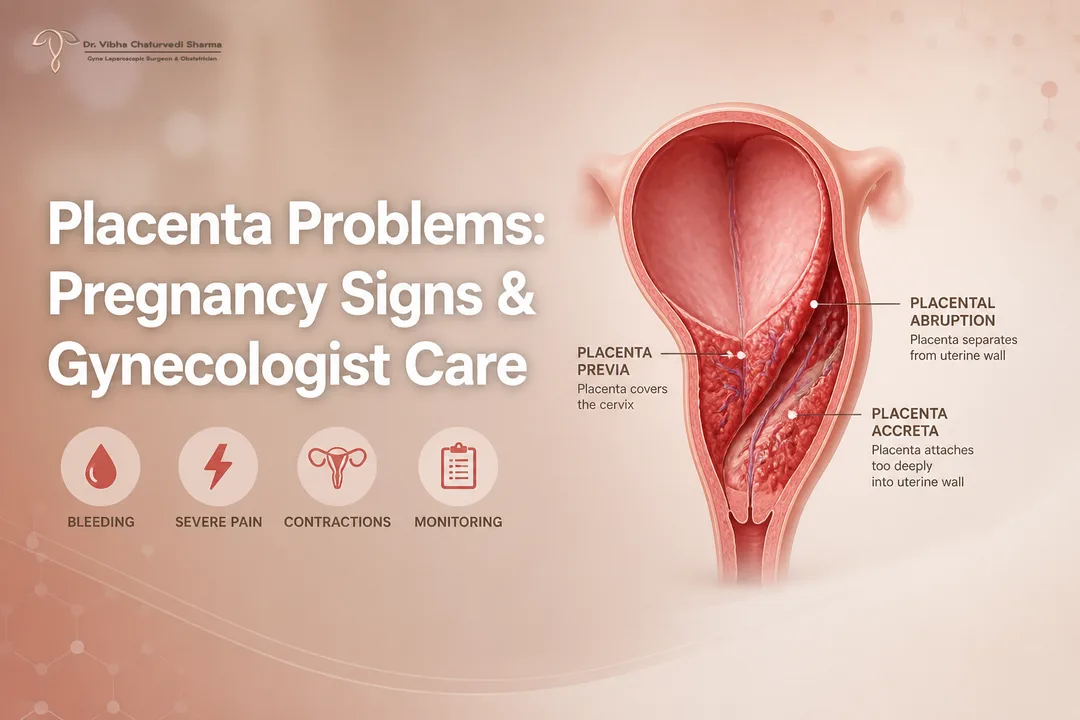
As a Gynecologist caring for families in Jaipur, I wrote this guide to “Placenta Problems During Pregnancy: Types, Warning Signs & When Expert Care Is Needed” so you can spot issues early and know when to act. You will learn what the placenta does, which problems occur, the red flags to watch for, and how timely specialist care keeps you and your baby safer.
What the Placenta Does and Why Problems Happen
The placenta is your baby’s lifeline. It delivers oxygen and nutrients while removing waste. It also produces essential hormones that support a healthy pregnancy. When the placenta sits too low, separates too soon, or invades too deeply, serious complications may follow.
In our Jaipur practice, we often meet mothers who feel fine yet carry hidden risks. Therefore, we look beyond symptoms and use ultrasound, Doppler blood-flow studies, and careful history-taking. Importantly, we review prior surgeries, blood pressure trends, and bleeding episodes at every visit.
Modifiable and Nonmodifiable Risk Factors
Some risks are outside your control, such as a previous Cesarean, multiple pregnancies, uterine surgery, or age over 35. However, several lifestyle factors raise risk as well. Smoking, uncontrolled hypertension, and trauma increase the chance of placental complications.
Simple steps that lower risk
- Stop smoking and avoid secondhand smoke; seek a cessation program early.
- Control blood pressure, diabetes, and thyroid disorders with regular checks.
- Use a seat belt correctly; it protects both mother and baby during travel.
- Attend all prenatal visits so we can catch position or bleeding changes promptly.
- Share your full surgical history; prior uterine procedures guide surveillance.
Major Types of Placental Complications
Placental conditions vary in severity. Some settle as the uterus grows. Others demand hospital care. Understanding the basics helps you respond with confidence.
Previa, Abruption, and Accreta at a Glance
Placenta previa occurs when the placenta covers part or all of the cervix. According to the NHS, placenta problems like previa affect roughly 1 in 200 pregnancies near term, and they often require planned delivery in a specialist unit (NHS placenta problems overview). Because the placenta blocks the exit, vaginal birth may be unsafe.
Placental abruption means the placenta separates from the uterine wall before birth. The Mayo Clinic notes it happens in about 1 in 100 pregnancies. Consequently, heavy bleeding and severe pain may occur, and urgent delivery can be lifesaving.
Placenta accreta spectrum (accreta, increta, percreta) happens when placental tissue grows too deeply into the uterus or beyond. Prior Cesareans raise the risk. ACOG provides detailed patient guidance on diagnosis and delivery planning, including the need for a coordinated surgical team (ACOG: Placenta Accreta Spectrum).
Red flags that need urgent evaluation
Seek help fast if you notice sudden heavy bleeding, severe constant belly pain, or contractions before term. Additionally, call if your baby’s movements drop noticeably. These signs can point to abruption or placenta previa complications.
Warning Signs Your Obstetrician Wants You to Know
Bleeding in the second half of pregnancy is the clearest warning. However, not all bleeding is dramatic. For instance, light spotting after activity can still be significant if you have a low-lying placenta. Therefore, rest and get checked the same day.
With abruption, pain is often sharp and persistent. You may feel a hard, tender uterus. Moreover, you might have back pain or dizziness. Because of this, do not drive yourself to the hospital. Arrange safe transport or call emergency services.
Low blood pressure, faintness, or shortness of breath can signal serious bleeding. Meanwhile, a sudden reduction in fetal movements deserves attention even without bleeding. Importantly, contact your maternity team if anything feels wrong. You know your body best.
As a clinic, we ask patients to save our number and pack pads, not tampons, in their maternity bag. That way, you can track bleeding and arrive prepared. Furthermore, we encourage partners to learn the signs as well. Team awareness buys precious minutes.
When a Gynecologist Should Step In Urgently
If you have bright red bleeding after 20 weeks, severe abdominal pain, trauma, or signs of preterm labor, a Gynecologist should assess you immediately. Early expert review prevents delayed decisions. In addition, ultrasound guidance in skilled hands improves accuracy and calms fears with clear visuals.
During triage, we check your pulse, blood pressure, and oxygen levels. Next, we assess the baby’s heart rate and movement. Then, we confirm placental position and look for bleeding behind the placenta. If bleeding is heavy, we start IV access and crossmatch blood. Notably, the NHS and ACOG both emphasize planning delivery timing with a senior obstetric team when placenta previa or accreta is suspected.
In our Jaipur units, we coordinate with anesthesia, neonatology, and the blood bank in advance for high-risk cases. Consequently, if you need a planned Cesarean or a balloon to control bleeding, the full team stands ready. For placenta accreta spectrum, we operate in a tertiary hospital where critical care and interventional radiology are available.
Questions to Ask Your Gynecologist
Good questions reduce anxiety and sharpen plans. Ask about your exact diagnosis and how it was confirmed. Then, ask what symptoms should trigger a hospital visit. Finally, clarify the delivery setting, blood readiness, and newborn support. For convenient continuity, you can book with Dr. Vibha Chaturvedi Sharma or reach our team through our Jaipur clinic.
Prevention, Monitoring, and Delivery Planning
While you cannot prevent every placental issue, you can reduce several risks. First, quit smoking and limit alcohol completely. Second, manage blood pressure and anemia. Third, space pregnancies when possible and attend every scan. Moreover, share previous operation notes; they inform delivery planning.
How delivery decisions are made
We weigh gestational age, bleeding amount, fetal well-being, and your medical history. If bleeding is light and you are stable, we may observe and plan a later delivery. However, persistent bleeding, pain, or fetal distress often leads to early birth. Safety guides every step.
What to Expect From Care at a Specialist Center
High-risk pregnancies benefit from a coordinated pathway. Therefore, you may see a maternal–fetal specialist, an anesthetist, and a neonatologist, alongside your primary obstetrician. Together, we create a plan that lists contact numbers, medication adjustments, and admission triggers.
For suspected accreta, we schedule imaging such as targeted ultrasound or MRI. Importantly, we consent you carefully and explain potential needs, including a blood transfusion. We never promise a specific outcome. Results depend on factors like placenta depth, placenta location, and overall health.
Education reduces emergencies. Consequently, we give written instructions for home rest, pelvic rest, and activity limits. We also teach counting fetal movements daily. If movements drop or bleeding restarts, you return for monitoring without delay.
Real-World Experience: Patterns We See in Clinic
Over the years, we have noticed clear patterns. For example, women with two or more prior Cesareans and a low-lying placenta at 20 weeks deserve close surveillance for accreta. In addition, we often see that early iron supplementation helps patients tolerate mild blood loss better during delivery.
We also find that clear communication prevents panic. When families know the plan, hospital arrivals are faster and safer. Above all, mothers feel supported. That confidence matters in urgent moments.
Frequently Asked Concerns, Answered Briefly
Can the placenta move up? Often, yes. As the uterus grows, a low-lying placenta may shift away from the cervix. However, true placenta previa rarely resolves late in the third trimester.
Will I always need a Cesarean? Not always. In some abruption cases with stable mother and baby, careful monitoring can allow vaginal birth. Nevertheless, previa that still covers the cervix usually requires a planned Cesarean.
Is hospital bed rest mandatory? It depends. We base decisions on bleeding pattern, distance from hospital, and support at home. Therefore, individualized plans work best.
Takeaway and Next Steps
Placental complications are serious, yet thoughtful care saves lives. The World Health Organization reports that hemorrhage remains a leading cause of maternal mortality worldwide, which underlines the value of early recognition and organized care (WHO global maternal health guidance). Therefore, learn the signs, keep your scans, and call promptly if something changes.
If you have questions or new bleeding, a Gynecologist can review your case and guide the next safe step. We will meet you with empathy, clear explanations, and a plan tailored to your medical history. When you feel informed, you make stronger decisions for yourself and your baby.
Contact & Appointments
📞 Phone: 78499 09109
📍 SURYA HOSPITALS
C-8, B-7, Sawai Ram Singh Road,
Opposite SMS Hospital, Jaipur
📍 UDBHAV
A-35, Prince Road, Ajmer Road,
Vidhyut Nagar, Jaipur, Rajasthan – 302019
Book your consultation today for expert laparoscopic treatment and comprehensive women’s healthcare.