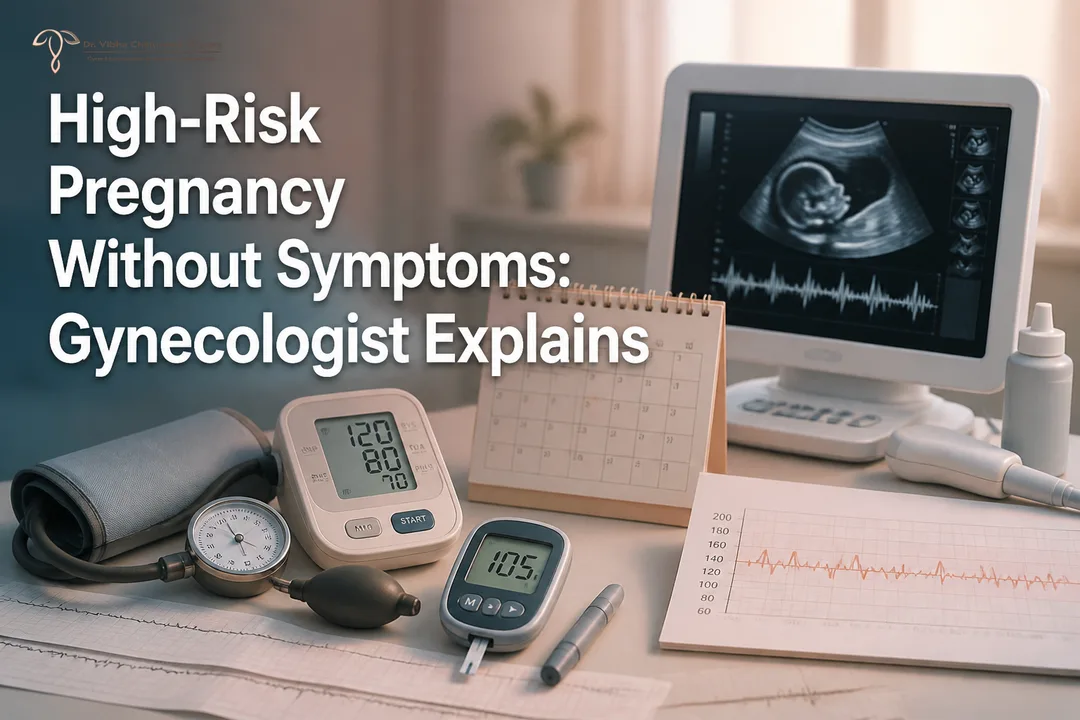
Many women ask a Gynecologist a puzzling question: why can a pregnancy be high risk even when they feel perfectly fine? High-Risk Pregnancy Without Symptoms: Gynecologist Explains tackles this paradox and shows you how to stay safe, informed, and calm.
Understanding the paradox: feeling well with hidden risk
In our high-risk clinic in Jaipur, we often meet confident, energetic mums-to-be whose tests still flag risk. They arrive for routine Prenatal Care and feel healthy. Yet measurements and scans may tell a different story. The body adapts in pregnancy, so early problems can stay quiet until they grow.
Consider blood pressure. Preeclampsia can start without warning headaches or swelling. According to the NHS, it affects up to about 6% of pregnancies, and severe disease is less common but dangerous. You might feel normal while numbers climb in the background. Screening catches it early, which protects both mother and baby. (NHS pre-eclampsia overview)
Similarly, gestational diabetes often causes no obvious symptoms. Many women discover it only during routine glucose screening. The Mayo Clinic notes that thirst or fatigue may not appear, which is why labs and a glucose challenge test matter so much.
Because of this, your feelings are not a reliable risk detector. Data is. Blood tests, blood pressure checks, growth scans, and a solid visit schedule form the safety net. When results look concerning, we adjust the care plan right away.
The silent drivers you might not feel
Blood pressure, placenta, and growth
High blood pressure narrows blood vessels. As a result, the placenta may not get enough flow to nourish the baby. You might not feel unwell, yet your baby’s growth percentile may start to drop. Ultrasound with Doppler and fundal-height tracking reveal the trend before symptoms show. Early action—like closer monitoring, medication, or timed delivery—can prevent complications.
Placenta previa or low-lying placenta also stays silent until later. We see it on ultrasound during routine Pregnancy Care. Most cases move upward as the uterus expands. However, persistent previa requires planning to prevent bleeding and may change the delivery route.
Blood sugar, anaemia, and infections
Even a modest rise in blood sugar stresses the placenta and the baby’s pancreas. Meanwhile, you feel okay. Tight control through diet, exercise, and medication when needed keeps growth and amniotic fluid in a healthy range. Anaemia is another quiet driver. It leaves some women tired, but many adapt. Iron studies and haemoglobin levels expose the deficit so we can treat it before birth.
As for infections, urinary tract infections in pregnancy may be subtle. Therefore, urine tests during visits are not just routine—they are protective. Treating an infection early reduces the chance of preterm labour and kidney issues.
When to See a Gynecologist
Feeling fine should not delay expert review. Schedule visits as advised, and come sooner if you notice changes. Regular Obstetrics appointments map a precise picture of your Reproductive Health over time.
- First trimester: book early to set baselines and discuss past medical history, PCOS or PCOD, prior Cesarean Section, or IVF conception.
- Second trimester: attend anomaly and growth scans on time; ask about blood pressure targets and weight gain goals.
- Third trimester: confirm kick-count technique, delivery planning for Normal Delivery or C-section, and Postnatal Care steps.
What Your Gynecologist Checks
During each visit, we combine your story with objective markers. We review blood pressure, weight trends, lab results, ultrasound findings, and the baby’s movements. We also discuss medicines, sleep, and stress, because lifestyle choices influence outcomes.
Baseline tests in the first trimester
Early labs cover haemoglobin, thyroid function, blood group and Rh status, and infection screens. We also check sugars if you have risk factors or a history of diabetes. Later on, a glucose test, growth scans, and Doppler studies show how the placenta and baby respond to pregnancy.
Importantly, evidence supports prevention in select cases. The American College of Obstetricians and Gynecologists advises low‑dose aspirin for women at high risk of preeclampsia, ideally starting between 12 and 16 weeks, and continuing until delivery. We follow this guidance when criteria are met. (ACOG low‑dose aspirin guidance)
A practical care plan that protects you and your baby
Here is how we help women who feel fine but carry extra risk. First, we map the risk source. Next, we design a Personalised Pregnancy Care schedule that balances clinic monitoring with home checks. Finally, we prepare a delivery plan that adapts as data changes.
Partnering with an Obstetrician
Your care team will set clear targets and simple routines. The steps below sound small, yet they work together like seatbelts and airbags.
- Track blood pressure at home if advised. Use the same arm and a validated cuff. Record the readings in a notebook or app.
- Follow your glucose plan. For some, that means nutrition coaching and a walk after meals. For others, it includes medication and a meter.
- Count movements daily from about 28 weeks. Choose the same time each day when the baby is usually active.
- Prioritise sleep and iron-rich, protein-balanced meals. Add prenatal vitamins only as prescribed.
- Know urgent red flags: severe headache, visual changes, sudden swelling, bleeding, leaking fluid, or reduced movements. Seek care at once.
Meanwhile, we coordinate scans and labs to match your risk. For placenta or growth concerns, we may add Doppler studies. For sugar issues, we time growth scans with closer third‑trimester visits. For anaemia, we recheck levels after treatment to confirm a response.
If you conceived through IVF or have a history of Female Infertility, the plan includes extra attention to thyroid balance, nutrition, and screening windows. This care remains evidence‑based and calm. It aims to support both Women’s Wellness and a safe delivery.
We also discuss delivery choices honestly. Many women with stable risk enjoy a Normal Delivery. Others benefit from a planned Cesarean Section. We weigh the trade‑offs openly and decide together. Results vary with the underlying condition, so an individualised plan is essential.
For complete support across Women’s Health—from Menstrual Disorders, Endometriosis, and Fibroids to Ovarian Cysts, Hysteroscopy, and Laparoscopic Surgery—our Jaipur team offers continuity before, during, and after pregnancy. Explore our approach at Dr. Vibha Chaturvedi Sharma, or learn about our broader, patient‑centric model of comprehensive women’s healthcare in Jaipur.
Why feeling okay can still be dangerous—mechanisms in plain words
Pregnancy changes your circulation, kidneys, lungs, and hormones. Therefore, readings can shift long before you sense trouble. Blood volume rises, so mild anaemia is common. Vessels relax, so early blood pressure may look normal, then jump later. Because nerves adapt, even swelling or breathlessness can feel typical. Objective checks cut through the noise.
Technology also hides risk in a good way. For instance, a simple urine dip picks up protein or infection. An ultrasound measures growth accurately and estimates placental blood flow. Consequently, you receive answers without guessing from symptoms alone.
Finally, prevention matters. If your history suggests preeclampsia or growth issues, we plan earlier follow‑ups. We also review calcium, salt, and activity, along with the aspirin strategy noted above. Small, consistent actions create safety margins that you won’t feel but your baby will benefit from.
Takeaway and next steps
In short, you might feel well and still carry a high‑risk pregnancy because many problems stay silent until late. Fortunately, data‑driven Prenatal Care finds them early and treats them in time. If you have any doubts, speak with a Gynecologist promptly to review your risk, visit schedule, and delivery plan. Our team provides balanced advice and respectful, patient‑centric care—no pressure, just clear options.
Book an appointment in Jaipur
📞 Phone: 78499 09109
📍 SURYA HOSPITALS
C-8, B-7, Sawai Ram Singh Road,
Opposite SMS Hospital, Jaipur
📍 UDBHAV
A-35, Prince Road, Ajmer Road,
Vidhyut Nagar, Jaipur, Rajasthan – 302019
Book your consultation today for expert laparoscopic treatment and comprehensive women’s healthcare.